I very much support this request if it is possible and straightforward. I would love to see Verox support OAAT and I definitely agree that it fits well with the Verox philosophy.
I have used Ropieee for as long as I have had Roon (I cannot remember but probably about 3-4 years). I moved over to Tune recently as a beta tester, and I reckon it is getting very good quickly and about a month ago I cancelled my Roon subscription because Tune does everything I want it to.
I have no affiliation to Tune apart from using it and reporting bugs & requests. I am impressed with the application, its rate of improvement and the responsiveness of the developers (including Claude).
Thanks for all the work on Verox - much appreciated. BTW I like the new colour scheme - reminds me of Noctua fans!
Possible it is, straightforward it is not. OAAT is a protocol (like Roon’s RAAT). The good news is that it’s open source, but there is no client afaik. That’s a serious amount of work…
I suppose whether it is worth integrating into Verox will depend on the take up of Tune, but this is partly why I like the idea of doing it - Verox would possibly increase uptake of Tune and vice versa. Anyway I won’t press any more for this I promise!
Thanks @sjt1970, you’re right and I stand corrected: there is an endpoint (tune-bridge), and that changes things.
The missing piece for Verox is convenience switching: when you start Roon or Spotify on the same device, Verox has to be able to tell Tune to stop, and OAAT has no way to do that yet. I’m going to add that, to the protocol and to the endpoint, and offer it upstream to the OAAT project. If that works out, OAAT will come to Verox. No promises on timing.
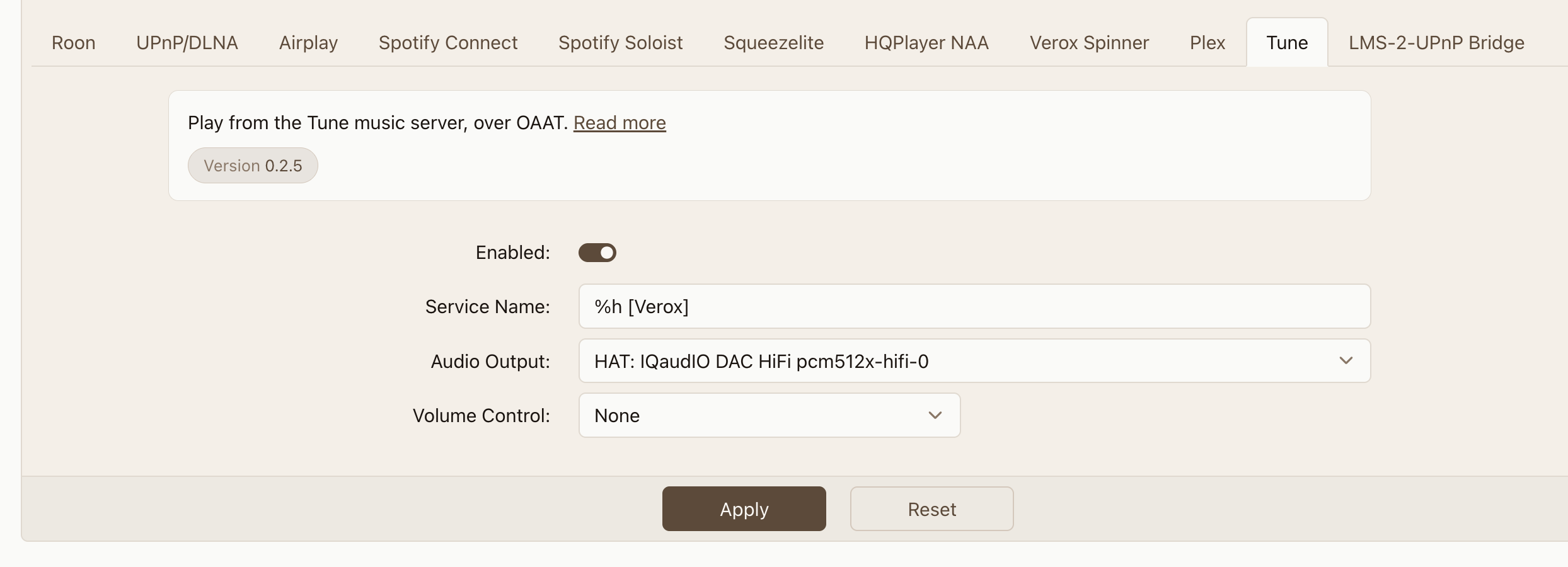
Volume control: that’s a bug in the web interface. The Tune tab doesn’t save that setting, so it always falls back to None. I’ve found it, and the fix will be in the next build. Until then the endpoint runs with fixed volume, which is why only Roon’s volume works.
The name: Verox gives the endpoint the name from Service Name on the Tune tab. With %h [Verox] that becomes “Atelier [Verox]”. If you prefer “Atelier - Verox”, enter %h - Verox there. Tune should then show that name, but it shows “Shairport Sync”, and I can’t see where that comes from on the Verox side yet. Was AirPlay enabled on this Pi at some point while Tune was running? Tune may have kept that name. Could you send logs (Advanced → Send Feedback) and post the reference? They show the exact name Verox announces to Tune.
Indeed! I had Airplay activated on the Pi, activated Tune, deactivated AIrplay. Identifier is 3dd331207e6e8a83
Looking at TuneServer logs: both AIrplay and Tune clients on the Pi are recognised, with the right naming. The issue is with Tune client, I have reported it.
2026-10-19T09:28:17.626+02:00  INFO tune_core::discovery::mdns: mdns_device_lost id=oaat:verox-01ae8794-3c6c-4d37-98a6-a12333e4637d name=atelier [Verox]

2026-10-19T09:28:17.634+02:00  INFO tune_server::discovery_setup: mdns_output_removed_zone_offline id=oaat:verox-01ae8794-3c6c-4d37-98a6-a12333e4637d

2026-10-19T09:28:18.363+02:00  INFO tune_core::discovery::mdns: mdns_device_discovered id=oaat:verox-01ae8794-3c6c-4d37-98a6-a12333e4637d name=atelier [Verox] service="_oaat._tcp.local."

2026-10-19T09:28:18.365+02:00  INFO tune_server::discovery_setup: mdns_output_registered name=atelier [Verox] host=192.168.1.17 port=9740 type="oaat"

2026-10-19T09:28:18.365+02:00  INFO tune_server::discovery_setup: mdns_zone_reconnected name=atelier [Verox] id=oaat:verox-01ae8794-3c6c-4d37-98a6-a12333e4637d

2026-10-19T09:28:20.201+02:00  INFO tune_server::discovery_setup: ssdp_recherche_a_la_connexion_d_un_client appareils=2

2026-10-19T09:28:32.462+02:00  INFO tune_core::discovery::mdns: mdns_device_discovered id=airplay-58:4e:08:16:f8:6f name=atelier [RoPieee] service="_airplay._tcp.local."
Thanks for checking the Tune log and reporting it to the Tune team. That confirms Verox announces the right name. The volume control fix is in the next build.
Yes - thanks again for doing this! I have got 2 Tune OAAT installs now - one on a Holo Red - this is flawless and works great - this outputs I2S to my Holo Spring 3 DAC. Tonight (for fun) I installed Verox on a Raspberry Pi with an Allo DigiOne Sig Hat that feeds SPDIF to my DAC but i cannot get audio out of the DigiOneSig Coax output. I know it works because I can run HQPlayer through this output but I cannot get the OAAT to work - i.e. no bitstream to the DAC. I dont know if I set it up wrong in Verox but I imagine the config is in the feedback - a31e7e8e4a6d36e2. Sorry for bothering you over this - I don’t need it but I thought I would tinker and I hope it helps iron out anything! Please let me know if I should report it Tune end. thanks again for this great support and functionality. I have been playing my Holo Red with OAAT all week!
Thanks for trying this, and no bother at all, this is exactly the kind of report that helps!
Your setup is fine. The feedback showed what’s going on: the OAAT endpoint sends 24-bit audio to the DAC in a 32-bit format. USB DACs like your Holo Red take that without complaint, but the DigiOne Sig only accepts 16- and 24-bit formats, so the endpoint couldn’t open it and nothing reached your DAC. HQPlayer works because it picks a format the DigiOne accepts.
I’ve made a fix: when a device doesn’t take the 32-bit format, the endpoint now sends the same audio in the 24-bit format instead, still bit-perfect. It’ll be in an upcoming beta. No need to report it to Tune: the problem is in the endpoint, and I’ll send the fix to its developers myself.
Glad to hear the Holo Red has been working so well all week!
One note: the fix I mentioned isn’t in 4203 yet, it comes with the next beta. What you’re playing now already reaches the DAC in a format the DigiOne accepts. Some other material can still be sent in the 32-bit format and stay silent until then. If you run into a track that plays on the Holo but not on the DigiOne, please send a feedback archive and let me know which track it was.
I didn’t spot that! I did a few tests (about 20 albums) and it seems that there is a pattern - DigiOneSig can play 16 bit songs but it cannot play 24 bit songs. This seems a pretty reliable pattern on all the stuff I tried. The last two I tried were Orbital Brown Album (44/16 - works) and Suzanne Vega Flying With Angels (48/24 - does not work) - feedback is aebf65bed1176e38. Hope this is helpful and thanks again
Very helpful, thanks! Your feedback shows exactly that: 16-bit tracks open the DigiOne in a 16-bit format and play, 24-bit tracks are sent in the 32-bit format, which the DigiOne refuses. That’s precisely what the fix handles, so with the next beta your 24-bit albums should play too. I’ll let you know here when it’s out.